














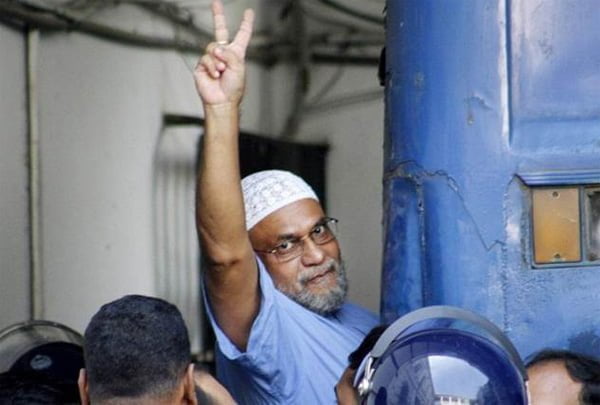
Bangladesh is on the verge of carrying out yet another controversial judicial execution of an opposition leader. Mir Quasem Ali, a well-known social entrepreneur, philanthropist and senior figure of Bangladesh Jamaat-e-Islami, is set to walk the gallows any moment after the Supreme Court appellate division dismissed his review petition and upheld the death penalty.
Although the government and its supporters have welcomed the verdict and are pushing for its quick implementation, critics have stated that the trial process was lacking in fair trial standards and did not provide justice to the real victims of crimes committed in the war of 1971, which led to the creation of Bangladesh. Moreover, in a twist that made matters more complicated, Mir Ahmad Bin Quasem, the son of Mir Quasem Ali and a lawyer of the defence team, was abducted on August 9, 2016 by men claiming to be members of detective branch of police from his residence in Dhaka. There is no news of his whereabouts since, and police have denied any involvement whatsoever.
 To summarize the case against Mir Quasem Ali, the prosecution pressed 14 charges of Crimes Against Humanity against him, all allegedly committed between 8th November 1971 and 16th December 1971 in Chittagong. The tribunal gave its verdict on his case on November 3, 2014, where the defendant was given the death penalty on two charges and sentenced to a collective period of 72 years in prison on eight other charges. He was found not guilty on four of the charges.
Later, Mir Quasem Ali appealed against the sentence at the Supreme Court Apellate Division. On March 8, the Supreme Court upheld the death sentence given by the tribunal on one charge, that of charge 11, while acquitting him of three other charges. On August 30, the Supreme Court Appellate bench dismissed the review plea by the defendant, leaving no bar to the execution of the death penalty by prison authorities.
The trial process, however, was accused of being deeply flawed and “marred” by “irregularities” by several international rights organisations, including UN experts, Amnesty International, Human Rights Watch, Bar Human Rights Council (BHRC) and others. Repeated statements by the defence team corroborate the observations by the rights organizations.First and foremost, the prosecution documents (news reports of the daily newspapers of November and December 1971) themselves show that Mir Quasem Ali was in Dhaka, i.e. away from Chittagong, during this entire period when the communications between these two cities were very bad due to the ongoing war.
 Despite the strong alibi, the defendant was apparently not allowed minimum opportunity to defend himself in this regard. Moreover, the Tribunal didnot put any restriction on the number of the prosecution witnesses, wherebytwenty-four witnesses were brought to testify. In contrast, the defence was allowed a limited number of three witnesses, despite their willingness to produce at least twenty witnesses.
The prosecution case was allowed to continue for five months, whilethe defence case, which commenced on 22.04.2014, was forced by the Tribunal to close on the very next day i.e. on 23.04.2014. Among the three defence witnesses, two were veteran freedom fighters of Chittagong who testified about Mir Quasem Ali’s innocence. Despite the defendant’s own willingness to testify, the Tribunal did not allow him to say anything in his own defence.
The charge on which Mir Quasem Ali was given the death sentence, that of the abduction, imprisonment, confinement and murder of freedom fighter Jashim and five other unnamed others, is an example of how questionable trial practices were employed to sentence the defendant to death. All the prosecution witnesses were hearsay witnesses, meaning they had heard the incident from somebody else. The documents provided by the prosecution in this charge, namely the book “Documentary Evidence of Freedom Struggle in Chittagong” (PramanneDalilMuktijuddheChottogram) by Chittagong University Professor and veteran freedom fighter Gazi Salahuddin, and the book “Shei ShomoyAnondoBedonay” by late Advocate Shofiul Alam. do not mention Mir Quasem Ali anywhere by name either. Moreover, the prosecution was unable to show any documentary evidence that Mir Quasem Ali was in Chittagong at the time of the events, proving instead that he was actually in Dhaka at the time.
 Taking the above into account, it is imperative that one tries to understand the real reason behind the sentencing of Mir Quasem Ali. The reason is political vendetta, pure and simple. The government, in its quest to wipe out its political opponents, has taken the recourse of eliminating them through sanctioned judicial murder. Mir Quasem Ali was not a political figure as such, but a social entrepreneur, a successful businessman and renowned philanthropist.
The sentencing of Mir Quasem Ali, on what is essentially flimsy evidence, and the abduction of his son Mir Ahmad Bin Quasem, a bright young lawyer, who is being held incommunicado by state intelligence agencies since August 9, without any charge, indicate the lowly depth that current government has delved into in order to realize its goals of eliminating its opponents. There are genuine fears that Mir Ahmad Bin Quasem, along with others who have been recently abducted such as Hummam Chowdhury, son of late Salahuddin Quader Chowdhury and ex-Brigadier General Abdullahil Amaan Azmi, son of late Ghulam Azam, will become victims of state sanctioned enforced disappearances, or be questionably implicated with terrorism charges over recent events such as the heinous Gulshan attacks.
 The opposition parties BNP and Jamaat-e-Islami, weakened by the excessive repressive activities of the government to contain and control their activities, have little to offer at this juncture, and have largely been inactive on national issues, citing the government actions as a threat to the multiparty democracy in the country. Repeated opposition movements to bring down the government and initiate fresh elections have failed miserably till date.
Meanwhile, the unnatural complicity of almost all local media with government narratives, alongside a silence on the global level against the government excesses and strong repressive measures in Bangladesh, in contrast to the spirited global response to the heinous blogger killings and terrorist attacks just a few months back, is only emboldening a steadily authoritarian Hasina government and its backers in the region and the international scene.
***Mohammad Hossain-Bangladesh\worlbulletin