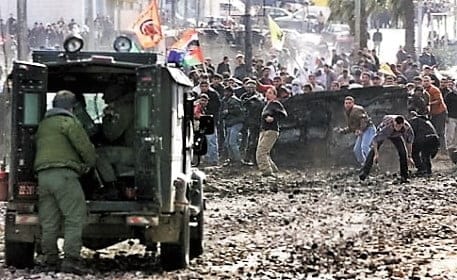
A Palestinian protest agaisnt Israeli repressions that started on December 9, 1987, has become know in history as the “First Intifada”. The First Intifada lasted up until signing of 1993 Oslo Accords.
The immediate cause of the uprising was when an Israeli army truck ran into a group of Palestinians in the Gaza Strip, killing four and injuring seven. The traffic collision had not been an accident. The day after the traffic deaths, Palestinians throughout Gaza Strip, West Bank and the East Jerusalem exploded with pent-up rage.
Even though the traffic killing triggered the protest, mass demonstrations had occurred a year earlier when, after two Gaza students at Birzeit University had been shot by Israeli soldiers on campus on 4 December 1986, the Israelis responded with harsh punitive measures, involving summary arrest, detention and systematic beatings of handcuffed Palestinian youths, ex-prisoners and activists.
 The overall Intifada was a protest against Israeli repression including beatings, shootings, killings, house demolitions, uprooting of trees, deportations, extended imprisonments, and detentions without trial.
According to the Save the Children Fund, in the first two year of the First Intifada 7 percent of all Palestinian minors were wounded by Israeli fire, beating or gas attacks. During the six-year-long Intifada over a 1,000 Palestinians were killed by Israel, over 120,000 were arrested, and thousands were injured.
Palestinian casualties have brought widespread international condemnation. UN Security Council resolutuions No. 607 and 608 were aimed to end Israel’s deportations. In November 1988, the majority of countries in the UN General Assembly condemned Israel’s actions against the Intifada. Any initiatives from the UN Security Coucil had little impact on Israel as its biggest ally on the issue happened to be the United States.
The First Intifada ended with signing of the Oslo Accords, the first ever high-level agreement between Israeli and Palestinian representatives.
The Oslo Accords marked the start of the Oslo process, a peace process that is aimed at achieving a peace-treaty based on the UN Security Council Resolution 242 and 338, and to fulfill the “right of the Palestinian people to self-determination”.