














 FOR Barisan Nasional (BN) and Pakatan Rakyat, it’s something like this – win some, lose some. Win here, lose there. Pretty much status quo. Sort of.
It was more of relief rather than euphoria for BN although it retained the federal administration, albeit performance worse than in 2008 . Not much excitement either for PR as they had expected to win the federal administration although they overall seats haul was better than five years ago.
No two thirds majority that the BN wanted in parliament. It was the same for the coalition at the state level. Like in Terengganu and Perak, BN kept power with a two and three seat difference, respectively. But even before polling BN’s Datuk Saifuddin Abdullah had “predicted” that the “the rakyat didn’t seem to want a party to rule with a two third majority”.
In short, the days of getting two thirds are gone. But the rakyat did give PR three states with two thirds majority – in Selangor, Kelantan and of course Penang. BN managed two-thirds majority in Melaka.
That’s one of the “contradictions” of GE13. (Incidentally, Saifuddin, seen as a reformist in Umno and one of the better young leaders in the party, lost his seat in Temerloh).
Another “contradictory” aspect would surely be on the voting trend itself. BN chairman Datuk Seri Najib Razak blamed the polls results on what he called the “Chinese tsunami”, going on to say “such polarised voting trends would be dangerous to the country”.
But results also showed BN pulled through because of Malay support for Umno. Should it called a “Malay tsunami” then? I for one don’t think so. True there was a big Chinese “swing” to Pakatan. But there was a Malay swing too, one which can be called an “an uneven swing’. “Uneven” because in some places the Malays gave their votes to BN/Umno and in others, their support went to PR.
For instance BN won Kedah with Malay votes as the state itself is Malay majority. Many BN wins elsewhere came from Umno with Malay support. Out of the 133 parliamentary seats won, Umno contributed 109.
But in Malay predominant Lembah Pantai , the majority of the Malays chose PR (Nurul Izzah Anwar). In Wangsa Maju as well where Malays are majority, they threw their weight behind PR’s non-Malay candidate, Dr Tan Kee Kwong. Both seats are in the Federal Territory of Kuala Lumpur. In other words, urban seats.
Said a researcher with a foreign university, “Chinese voters’ trend clearly was to the opposition but Malay voters seem mixed.” To some observers the BN support came from what they termed as the “Malay heartland”. Another word for “heartland” would be rural, some say.
Hence BN/Umno support as in previous years came from rural Malays while the majority of urban Malays made up of upper middle class, middle class as well as lower income voted for PR. Hence the divide is rural and urban.
MCA president Datuk Seri Dr Chua Soi Lek however sadly preferred to paint a picture of a “two race system” being formed by the polls results – one which is a “victory of the Chinese over the Malays”.
DAP’s Lim Kit Siang took exception and urged Chua “not to racialise the electoral results”, adding that Chua’s remarks “is a betrayal to the vision of Malaysians as well as the 1Malaysia spirit touted by BN”.
According to Lim he would not have obtained a big majority in defeating Datuk Ghani Othman in Gelang Patah without the substantial Malay support. His son Guan Eng also said PR’s overwhelming victory in Penang was achieved with the support of the Malays as well, not only Chinese voters .
Without Malay support, said Lim junior, “we could not have the two thirds majority”.
To former Melaka CM Datuk Seri Ali Rustam who lost in Bukit Katil, the “Chinese did not appreciate the service and efforts undertaken by the BN government.” This and Chua’s statement are at odds with Najib’s stated concern over “polarisation” and the need to reject “racial politics and extremism”.
That would surely be contradiction number three as far as GE 13 goes – for Umno including former PM Tun Mahathir Mohamad and Najib himself had used time and time again the “favourite” campaign line of the “Malays and Islam under threat” and the “danger of Malays losing its identity” should PR come into power.
And Umno had endorsed Perkasa’s Datuk Ibrahim Ali and Datuk Zulkifli Noordin, the two men who had hurt the feelings of non-Malays with their remarks seen by many as “racist”.
“The good news is people are rejecting Ibrahim and Zulkifli,”said the researcher. The “people” the researcher was referring to are obviously the voters in Pasir Mas and Shah Alam who are predominantly Malays.
Najib has admitted BN will “take some time to absorb the results and its ramifications”. Well, one aspect that BN/Umo need to take a hard look at will have to be using the “Malay card”.
But the BN win this time is marred by allegations of electoral fraud. PR’s Datuk Seri Anwar Ibrahim listed many of what he sees as irregularities and suspicions. Fact is many Malaysians feel the same. The degree of mistrust towards the Election Commission (EC) was (and still is) so high many ordinary Malaysians became self appointed election watchers in an effort to stop fraud.
The EC has denied everything. So too Najib who said the elections “are clean and fair”. But that is still being disputed. And not likely to go away anytime soon.
A victory is a victory they say. Still the BN victory this time seems “hollow” taking into consideration the money and effort spent – not only during the campaign period but since 2009.
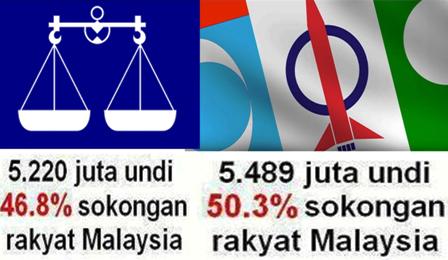
Despite all that the scoreboard read BN 133, PR 89. In 2008 it was BN 140, PR 82. And we all know what happened to the then Umno President and Prime Minister Tun Abdullah Ahmad Badawi because of that.
As far as politics goes, it’s still game on.- fz